
Solutions Enhancing the Economics of Desalination

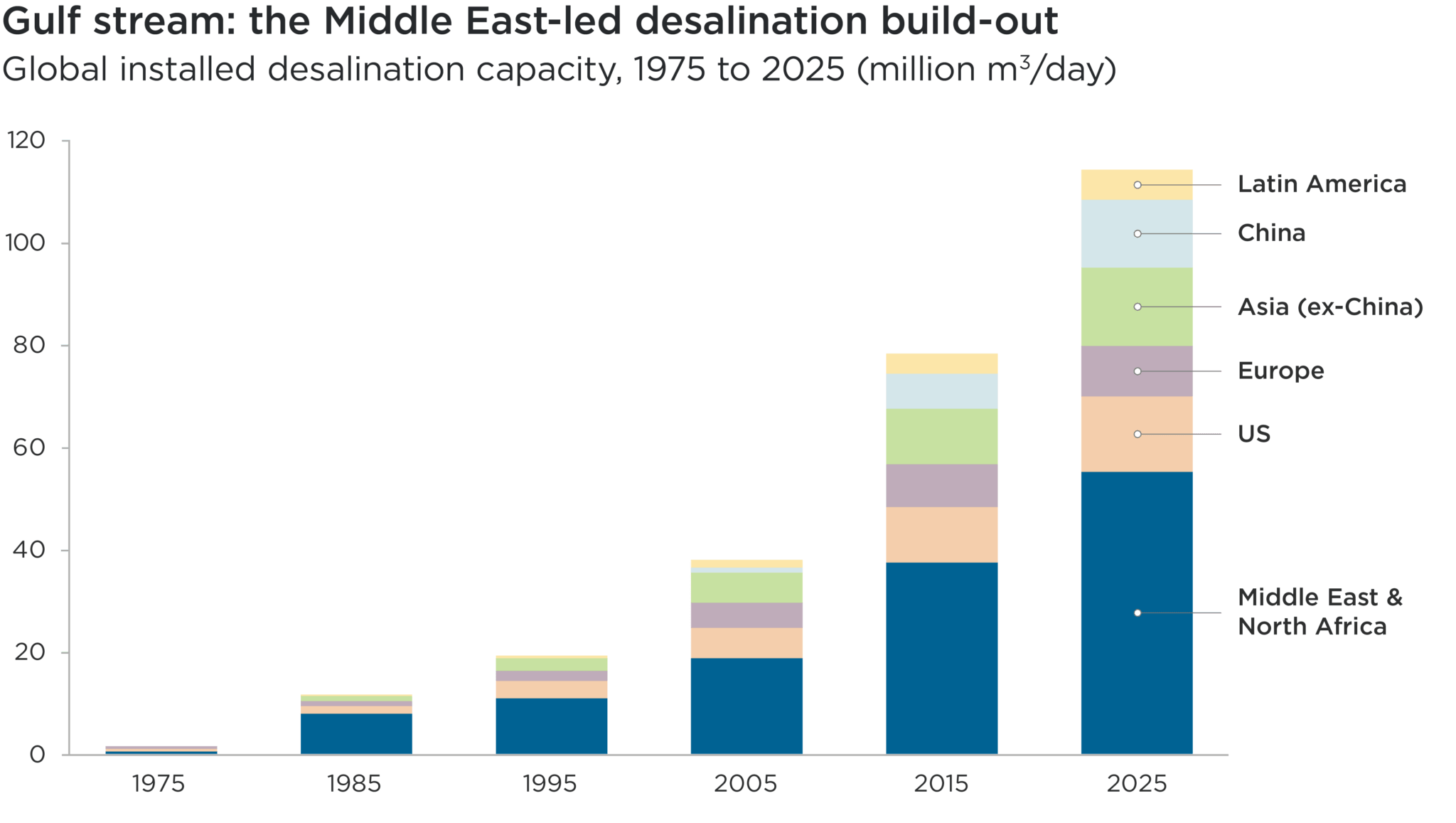
Almost a century has passed since the world’s first large-scale seawater desalination plant was built on the Caribbean island of Aruba.1 Today, it is estimated that around 18,000 facilities produce roughly 100mn m³ of desalinated seawater each day.2
Yet this represents barely 1% of total global drinking water. The process’ high energy intensity, as well as freshwater availability, have largely confined desalination’s role to arid coastal regions where there are few alternatives – especially the Gulf states, where there is also abundant, low-cost energy.
Rising pressure on finite freshwater resources, from population growth and industrial uses, has combined with more intense droughts and Middle Eastern conflict to prompt renewed focus on desalination, however. Improved technologies have meanwhile significantly lowered its costs.
Investment has led to a 40% expansion in global installed desalination capacity between 2020 and 2025, with sustained growth forecast.3 Over US$25bn of capital expenditure is planned in the Middle East alone between 2024 and 2028.4
We believe that desalination’s growing role in addressing rising water scarcity supports opportunities across the value chain: from providers of critical technologies to the utilities operating plants and consultants supporting them.
The strategic role of desalination
Desalination plays a critical role in meeting rising baseload demand in some of the driest regions.5
The Middle East and North Africa – where desalination has supported urban expansion and economic growth in the face of severe water scarcity since the 1970s – host almost half of global installed capacity. Qatar sources 77% of its freshwater and 99% of drinking water from desalination, for instance.6
Elsewhere, not least in Southern Europe where climate change is intensifying pressure on water resources, governments are investing in desalination for drought insurance. In Spain, which accounts for approximately three-fifths of European desalination, the government has committed €23bn to double its installed capacity (including reuse).7
Importantly, the expansion of desalination capacity is not only to provide municipal drinking water. Most installed capacity in Asia, including China, serves industrial end uses (including power generation and refining) where reliable water supplies are operationally critical.8
Scale and technologies narrow the cost gap
Desalination is an energy-intensive method for producing potable water, requiring between five and 25 times as much energy than treating surface freshwater.9 Consequently, the cost of desalinated water remains one-and-a-half to four times higher than traditional freshwater sources, such as reservoirs or shallow wells.10
While the cost-competitiveness of desalination plants therefore hinges on local energy costs – typically low in Gulf economies – the average lifecycle costs of production are estimated to have fallen by as much as 60% over the past three decades.11
Economies of scale are part of the equation: the average new desalination plant is about 10 times larger than in 2010, according to the IEA.12 One plant in Saudi Arabia alone produces over 1mn cubic meters of water per day.13
Adoption of advanced membrane technologies and energy recovery devices (the latter produced almost exclusively by a specialist US company called Energy Recovery) has also driven down costs. Within the former, reverse osmosis systems developed by the likes of US-listed Xylem essentially remove salt by pushing seawater through a superfine, semipermeable membrane under very high pressure.
The energy intensity of reverse osmosis is being lowered by innovations including high-efficiency pumps, advanced thin-film composite membranes (which can lower water pressure requirements) and isobaric energy recovery systems (which transfer almost all of the hydraulic pressure from the high-salinity brine waste stream directly to the incoming seawater stream). The latter can reduce the power consumption requirements of high-pressure feed pumps by up to three-fifths.14
Disposal of this waste is a key environmental challenge for the desalination industry, which generates 1.3bn m3 of brine each year.15 Typically, it is diluted with wastewater to reduce salinity before being discharged into the ocean, although this can still harm marine ecosystems. There is therefore a push towards zero-liquid discharge, whereby the brine waste is crystallised into solid salts that can be isolated and used as chemical feedstocks or road salts.
Another innovation – deep-sea intake and subsea desalination – is meanwhile being piloted off the coast of Nice in France.16 These systems could yield further reductions in energy intensity by using greater hydrostatic pressure and cleaner water at depth.
The desalination value chain
Sitting alongside providers of critical technologies in the desalination value chain are the companies constructing and operating plants, and the consultants who partner with the industry.
Among the former, Veolia is one of the world’s largest operators of desalination plants, including in the Middle East. The French-listed company also claims the largest share of global installed desalination capacity: almost one-fifth (18%) of capacity has been built using its technologies.17 It aims to maintain this market share and double its operational and maintenance capacities between 2025 and 2030.
Among the latter, the likes of Arcadis provide planning, engineering and asset management services across the full water cycle. As well as leading aspects of specific projects – such as designing the largest US desalination plant in San Diego – the Dutch-listed company advises utilities and municipalities on broader water management plans, including investments to navigate water scarcity.18
A key component of water resilience
Only in the driest parts of the world is desalination the lowest-cost or first-choice option for producing clean water. In most regions, investments in upgrading networks, reducing leaks and reusing water will make more economic sense.
Nonetheless, as more intense droughts and conflict risk push water security up the policy agenda in many countries, desalination can clearly help contribute to mitigating water scarcity risks.
As climate change increases the frequency and intensity of droughts, including in regions historically blessed with steady rainfall patterns, desalination can act as a strategic backstop to help ensure continuity of supply to households, industry and agriculture. For example, the technology is now being seriously considered by UK-listed Pennon, the utility that supplies water in southwest England – a famously wet region – to enhance system resilience.
With innovation continuing to drive down costs and environmental impacts, and with drought risks rising, desalination can play an increasingly important part of the water supply mix.
1International Desalination and Reuse Association (IDRA), 2026
2Global Desalination Forum, 2026
3EU Blue Economy Observatory, 2026
4Khanzada, N.K., January 2026: Desalination and the Middle East: research, practices, implications, and prospects. NJP Clean Water
5MIT Technology Review, April 2026: Desalination technology, by the numbers
6Frontiers in Water, October 2025: Evolution of desalination research and water production in the Middle East: a five decade perspective
7Aquatech, January 2026: Desalination continues to drive water security strategies
8IEA, March 2026: Wired for water: How electrification is transforming desalination
9Benahmed, A., et al., 2025: Investigating the long-term economic sustainability and water production costs of desalination plants: A case study from Chatt Hilal in Algeria. Egyptian Journal of Aquatic Research
10Trends Group, 2025: The Future of Desalination: Between Financing and Climate Challenges
11EU Blue Economy Observatory, 2026
12IEA, March 2026: Wired for water: How electrification is transforming desalination
13Crownhart, C., April 2026: Desalination technology, by the numbers. MIT Technology Review
14Flowserve, 2026
15Liu, Y., et al., March 2026: Simple mass transfer regulation achieves scaling-free zero liquid discharge of seawater desalination brine without chemical additive. Science Advances
16H2O Global News, January 2026: OceanWell and Eau d’Azur Sign MOU to Advance Subsea Water Farm in France
17Veolia, 2025: Veolia, the global champion of sustainable desalination, set to double its operated capacity by 2030
18Arcadis, 2026: One Water strategies overcome growing challenges