
Smart Technologies Plugging Water Network Leaks

Water scarcity is a present and escalating crisis amid more volatile rainfall patterns and rising consumption. Regions home to half the world’s population now face severe water stress for at least part of the year.1 Yet worldwide, an estimated 30% of treated water is lost before it reaches the tap.2
In this context, water utilities are under increasing pressure from regulators – and the public – to improve the efficiency of their networks. They have financial incentives to do so, too.
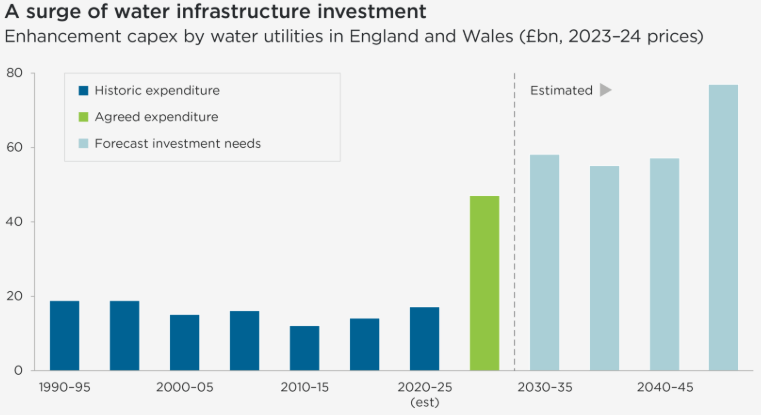
A wave of investment is now planned by water utilities to upgrade their ageing infrastructure. We believe this should provide structural long-term demand tailwinds for technological solutions that help them identify and predict – and so quickly repair – leaks.
Regulatory and financial pressures to stem losses
To meet rising demand and address risks posed by climate change, the World Bank has estimated that roughly US$1tn a year needs to be invested this decade to improve the resilience and sustainability of the world’s water infrastructure.3 Much of this needs to be directed towards upgrading and fixing ageing networks.
Losses from distribution networks are driven by a combination of old pipes (one-fifth of pipes in the US and Canada have exceeded their useful lives), shifting ground conditions (often due to extreme weather), and the inherent challenge of monitoring thousands of kilometers of buried assets.4
Rising to these demands imposes costs on water utilities, but fixing leaks should prove less expensive than the alternatives. Unless the efficiency of distribution networks is improved, additional water storage and treatment infrastructure would be needed to meet rising demand from consumers and water-intensive industries like data centres. For context, it is estimated that building a 150bn litre reservoir near Oxford – with new storage capacity equivalent to the annual consumption of 1.2mn UK households – will cost as much as £7.5bn.5
Targeted investments to stem losses of treated water should therefore prove highly cost-effective. The largest listed US water utility, American Water Works, expects its programme of water-saving projects to yield up to US$1.5bn in annual savings by 2030.6
Identifying and predicting network leaks
Among the advanced technologies being adopted by water utilities, four stand out. We expect demand for each to rise as utilities ramp up investment in their networks.
The first cornerstone technology for stemming network losses is smart metering. These devices, made by the likes of US-listed Xylem, provide real-time data that helps utilities identify anomalies including continuous flow – often an indicator of a hidden leak – in homes and other points of consumption. This allows them to pinpoint leaks and repair them quickly.
Severn Trent, a UK-listed utility that supplies water to over 8mn people in the Midlands and Wales, is installing one million smart water meters as part of a broader £13bn investment programme for 2025 to 2030.7 Having reduced leakage by 29% since 2005, despite population growth of 22%, the company is looking to accelerate the rate at which it identifies and then tackles leaks.
Two additional monitoring technologies are also being widely adopted by water utilities: acoustic listening devices and satellite leak detection. The former (also made by Xylem) are sensors that ‘listen’ for the sound of escaping water and so, like smart meters, can help pinpoint leaks in real time. United Utilities, which supplies roughly 7mn people in northwest England, has installed over 72,000 acoustic loggers to reduce network losses.8
Synthetic aperture radar (SAR) satellite technology, meanwhile, is being used by the likes of United Utilities to detect underground leaks across entire networks. L-band satellite radar signals penetrate up to 3 metres below the ground to recognise abnormal levels of soil moisture. When overlaid onto a network map, leaks can be precisely identified.
Monitoring hardware is increasingly being used as inputs for advanced ‘digital twins’ of real-life systems.
American Water Works, which provides drinking water and wastewater treatment to over 14mn people across 14 US states, has partnered with Xylem to segment its network into ‘virtual district metering areas’.9 Using continuous data from smart meters, leaks in specific neighbourhoods can be immediately detected by abnormal and persistent spikes in flow, enabling their swift resolution.
Further, Xylem is enabling American Water Works to shift from reactive maintenance towards predictive maintenance. By analysing pipe age and historical break data, AI-powered forecasting software can predict which sections of the network are most likely to fail, allowing more effective prioritisation of repairs – before they lead to water losses.
Smarter, more resilient water infrastructure
The regulatory and financial incentives for utilities to invest in smarter, more resilient water networks combine to forge a constructive environment for suppliers of these innovative solutions.
It also supports opportunities for leading consultants with whom many utilities partner to integrate and operate advanced hardware and software solutions. US-listed consulting and engineering services company Tetra Tech has contracts with several water utilities, including Severn Trent and United Utilities, to provide a unified, data-driven solution to help manage leakage, streamline reporting and meet regulatory requirements.
For the utilities themselves, those that effectively leverage innovation to improve their networks’ efficiency should avoid regulatory censure and alleviate pressures to make more costly infrastructure investments.
As the environmental and social posts of water mismanagement come into closer focus, we believe this trend supports demand growth for products and services that help plug leaks and strengthen the overall resilience of water systems.
1Unesco, 2024: World Water Development Report 2024
2Global Water Intelligence, March 2025: Plugging the leak: Innovative solutions for reducing water loss and its economic impact
3World Bank, 2024: Closing the $7 Trillion Gap: Three Lessons on Financing Water Investments from World Water Week
4Barfuss, S.L., 2024: Water Main Break Rates in the USA and Canada: A Comprehensive Study. Utah Water Research Laboratory
5BBC, 14 August 2025: Reservoir costs set to triple to up to £7.5bn
6USA Works, July 2025: Investing in U.S. Water Infrastructure: Navigating a $1 Trillion Opportunity
7Severn Trent, January 2026
8United Utilities, January 2026: Leakage performance
9American Water Works, October 2025